The Quantum
Quantum Field theory
Fermilab Quantum Field Theory
What is it?
Fields, the ones described by physics, are defined as a region in which each point is affected by a something such as a force. Each, and classically anywhere, and any point you choose is assigned a number representing the field strength at that point usually expressed as a force in Newtons. However, it could be another value such as a temperature, a pressure, or any scalar.
A scalar field assigns a single number to every point in a region of space, effectively describing the "amount" of a quantity at each location. This is the simplest type of field, focusing on a single scalar value rather than vectors or other more complex quantities.
A vector field is an assignment of a vector to each point in a space, most commonly Euclidean space. A vector field on a plane can be visualized as a collection of arrows with given magnitudes and directions, each attached to a point on the plane. A vector includes a value and a direction. The magnetic field around a planet or a star could be a vector field as the strength of magnetic field at a point could also have a direction.
A gravitational field is a force field that exists around any mass, creating an attractive force between it and other masses. This field is a vector field, meaning it has both magnitude and direction, indicating the strength and direction of the gravitational force at any given point in space. The strength of a gravitational field is directly proportional to the mass of the object creating the field and inversely proportional to the square of the distance from that object. The gravitational field, generated by mass, attracts everything around it. Objects are attracted to each other based on their mass and the other object’(s) mass. Based on the separation between them a number can be assigned to each point that represents the force of the gravitational field at that point. It is expressed in Newtons per kilogram of mass or in acceleration of meters per second squared.
The electric field strength is measured in newtons per coulomb (N/C) or volts per meter (V/m). The force experienced by a very small test charge q placed in a field E in a vacuum is given by E = F/q, where F is the force experienced and q is the charge generally measured in coulombs.
For the strong force the strength is modified by the gauge color charge of the particle, a group theoretical property. The strong force acts between quarks. Unlike all the other forces mentioned, the strong force does not diminish in strength with increasing distance between pairs of quarks. It’s the one responsible for holding quarks together forming protons and neutrons
What Is the Universe, Really? | Leonard Susskind
In this video, he explores a more fundamental question: what is the universe really made of? Is it space? Matter? Energy? Or something far more abstract than our everyday intuition allows? Drawing on ideas associated with Leonard Susskind, this long-form exploration challenges the assumption that the universe is a physical stage where reality takes place. Instead, physics increasingly points toward a universe defined not by objects and locations, but by information, relationships, and boundaries.
Black hole physics, quantum theory, and modern cosmology have forced scientists to rethink the foundations of reality. In some of the deepest descriptions of nature, space and time no longer appear as fundamental ingredients. What we experience as a three-dimensional universe may be an emergent structure — a convenient description rather than the true underlying reality.
Rather than focusing on equations, this video emphasizes intuition and conceptual understanding. Through thought experiments and simple analogies, we examine why the universe feels like a place, why that picture works so well at human scales, and why it may break down at the most fundamental level.
If the universe is not what we think, then questions about inside and outside, beginning and end, and even existence itself must be reconsidered. Understanding what the universe really is requires letting go of familiar images and accepting that reality may be far stranger — and far simpler — than it appears.
This video is a slow, reflective documentary for viewers who want to look beyond surface explanations and explore how modern physics reshapes our understanding of the universe at its deepest level.
If you wished to ask the question ‘what's truly fundamental in this Universe’, it would be necessary to research matter and energy on the smallest possible scales and, of course, to understand fields.
What is a Field?
Royal Institute - What is a field
If one was to imagine a gridwork throughout space, and even time, we could assign a coordinate to each of those cells making up a minute spacetime place. One could assign a value to each of those cells with the number representing a physical value. In an environmental chamber we could measure the temperature at each point of both space and time. We would have a four-dimensional gridwork with coordinates of a three-dimensional position and a time of measurement. We could call this the temperature ‘field’. We could do this for humidity and light intensity in our environmental chamber. If we wanted our fields to be more fundamental, we could map the electromagnetic field, the strong force, the weak, Higgs and gravity fields. We would have a gridwork with all the numbers required to represent the elements of the universe. Each point in our universe, both space and time, would have a set of numbers with the field strengths of each type of fundamental physical field.
The fields would be there and, without any perturbations, are the energy of the universe in its quiescent state. When they have a value, when they oscillate this represents a particle in the field with the value in units of force, usually Newtons.
Richard Feynman on Fields?
What is a Field
Fields are one of the most important ideas in modern physics and one of the least intuitive. This long-form explanation explores what physicists mean by fields and Feynman explains it so well.
Instead of treating fields as abstract mathematical tools, Richard Feynman explains how physics understands them: physical conditions assigned to space and time that determine how objects behave locally and how influence propagates. The video avoids complicated mathematics and focuses directly on meaning, using familiar physical situations to build a clear picture.
The presentation questions hidden assumptions, rejecting vague explanations, and insists that ideas make sense when pushed to their foundations. The topics talked about by Feynman include: What a field is at the most basic level, why fields replace action across distance, how electric, magnetic, and gravitational fields guide motion, why fields exist even where no matter is present, how fields carry energy and influence.
What is a Particle?
Arvin Ash What is a Particle
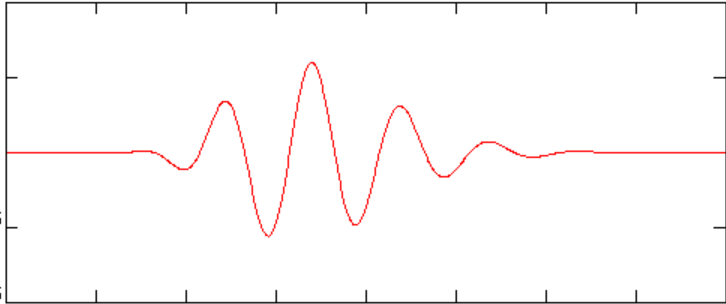
To put it simply it is a vibration in a field. Each different boson particle has its own field; the photon has the electromagnetic, mass has a gravity field (though this one seems a bit different and the graviton has not be exposed yet) and quarks have the short range field of the strong force, the gluon and the Higgs has, well, the Higgs field. Their particles, called bosons, are vibrations in their respective field. Bosons act as the force ‘carrier’ and affect fermions bonding or repelling them.
Let’s look at the photon. I know this sounds funny because we usually ‘look’ using photons so how do we look at it? With our minds.
Photons come in discreate packets. The energy of each of these packets is proportional to their frequency, meaning the higher the frequency then the greater the energy. A very simple formula developed by Planck demonstrates this
What's Planck got to say?
e=h x f
Note that Planck used v as the symbol for frequency, but I will choose f.
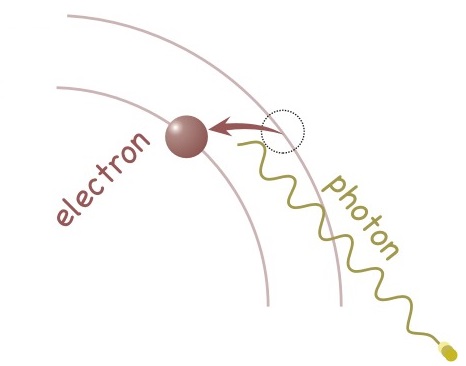
It was noticed a long time ago that by shining light on certain kinds of metals, electrons would pop out; the photo electric effect but, as quantum physics has it, it’s not that simple. When the light hits the metal, the energy is transferred in discrete packets and not completely linearly proportional as the above equation could lead us to believe. Oh yes, it is proportional, but only in discrete steps. Those packets come out in a quanta. The photon is a ‘ringing’ of the electromagnetic field and the energy of this photon is transferred to the metal surface by way of the electromagnetic field and the energy is absorbed by the electrons in the metal, if it’s the correct frequency. And if so, an electron is released.
We can’t describe this photon of existing in a particular position, it is a wave and even more strange, its position is probabilistic.
Yes, a wrinkle in the electromagnetic field propagating a quanta of energy through more than one possible place making its presence known when it interacts with something like an electron.
The particles describing reality, such as the photon described above, could no longer be described solely as particle-like. Instead, they had elements of both waves and particles, and behaved according to an ad-hoc set of rules, not like classical physics at all.
Initially, these descriptions troubled physicists a great deal. These troubles didn't simply arise because of the philosophical difficulties associated with accepting a non-deterministic Universe or an altered definition of reality, although certainly many were bothered by those aspects. The difficulties were a bit deeper than that. The theory of special relativity was well-understood and had proven itself over and over but it seems that quantum mechanics, as originally developed, only works for non-relativistic systems. By transforming quantities such as position and momentum from physical properties into quantum mechanical operators — a specific class of mathematical function — these bizarre aspects of reality could be incorporated into our equations. But that’s another story.
Quantum field theory came about with the study of electromagnetic interactions. The electromagnetic field was really the first field to be understood and is called quantum electrodynamics but really the first field theory was described by Newton, gravity.
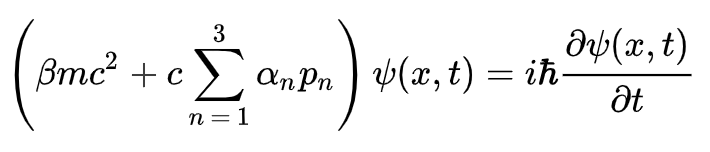
But the way you allowed your system to evolve depended on time, and the notion of time is different for different observers. This was the first existential crisis to face quantum physics.
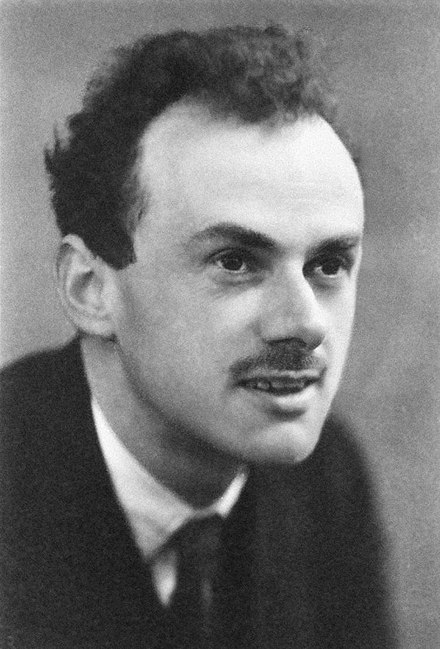
We say that a theory is relativistically invariant if its laws don't change for different observers: for two people moving at different speeds or in different directions. Formulating a relativistically invariant version of quantum mechanics was a challenge that took the greatest minds in physics many years to overcome and was finally achieved by Paul Dirac in the late 1920s.
The result of his efforts yielded what's now known as the Dirac equation, which describes realistic particles like the electron, and accounts for:
• antimatter
• intrinsic angular momentum (a.k.a., spin)
• magnetic moments
• the fine structure properties of matter
• and the behavior of charged particles in the presence of electric and magnetic fields
This was a great leap forward, and the Dirac equation did an excellent job of describing many of the earliest known fundamental particles, including the electron, positron, muon, and even (to some extent) the proton, neutron, and neutrino.
But it couldn't account for everything. Photons, for instance, couldn't be fully described by the Dirac equation, as they had the wrong particle properties. Electron-electron interactions were well-described, but photon-photon interactions were not. Explaining phenomena like radioactive decay were entirely impossible within even Dirac's framework of relativistic quantum mechanics. Even with this enormous advance, a major component of the story was missing.
The big problem was that quantum mechanics, even relativistic quantum mechanics, wasn't quantum enough to describe everything in our Universe.
Think about what happens if you put two electrons close to one another. If you're thinking classically, you'll think of these electrons as each generating an electric field, and also a magnetic field if they're in motion. Then the other electron, seeing the field(s) generated by the first one, will experience a force as it interacts with the external field. This works both ways, and in this way, a force is exchanged.
This would work just as well for an electric field as it would for any other type of field: like a gravitational field. Electrons have mass as well as charge, so if you place them in a gravitational field, they'd respond based on their mass the same way their electric charge would compel them to respond to an electric field. Even in General Relativity, where mass and energy curve space, that curved space is continuous, just like any other field.
The problem with this type of formulation is that the fields are on the same footing as position and momentum are under a classical treatment. Fields push on particles located at certain positions and change their momenta. But in a Universe where positions and momenta are uncertain, and need to be treated like operators rather than a physical quantity with a value, we're short-changing ourselves by allowing our treatment of fields to remain classical.
That was the big advance of the idea of quantum field theory, or its related theoretical advance: second quantization. If we treat the field itself as being quantum, it also becomes a quantum mechanical operator. All of a sudden, processes that weren't predicted (but are observed) in the Universe, like:
• matter creation and annihilation
• radioactive decays
• quantum tunneling to create electron-positron pairs
• and quantum corrections to the electron magnetic moment all made sense.
Although physicists typically think about quantum field theory in terms of particle exchange and Feynman diagrams, this is just a calculational and visual tool we use to attempt to add some intuitive sense to this notion. Feynman diagrams are incredibly useful, but they're a perturbative (i.e., approximate) approach to calculating, and quantum field theory often yields fascinating, unique results when you take a non-perturbative approach.
But the motivation for quantizing the field is more fundamental than that the argument between those favoring perturbative or non-perturbative approaches. You need a quantum field theory to successfully describe the interactions between not merely particles and particle or particles and fields, but between fields and fields as well. With quantum field theory and further advances in their applications, everything from photon-photon scattering to the strong nuclear force was now explicable.
At the same time, it became immediately clear why Einstein's approach to unification would never work. Motivated by Theodr Kaluza's work, Einstein became enamored with the idea of unifying General Relativity and electromagnetism into a single framework. But General Relativity has a fundamental limitation: it's a classical theory at its core, with its notion of continuous, non-quantized space and time.
If you refuse to quantize your fields, you doom yourself to missing out on important, intrinsic properties of the Universe. This was Einstein's fatal flaw in his unification attempts, and the reason why his approach towards a more fundamental theory has been entirely (and justifiably) abandoned.
The Universe has shown itself time and time again to be quantum in nature. Those quantum properties show up in applications ranging from transistors to LED screens to the Hawking radiation that causes black holes to decay. The reason quantum mechanics is fundamentally flawed on its own isn't because of the weirdness that the novel rules brought in, but because it didn't go far enough. Particles do have quantum properties, but they also interact through fields that are quantum themselves, and all of it exists in a relativistically-invariant fashion.
Perhaps we will truly achieve a theory of everything, where every particle and interaction is relativistic and quantized. But this quantum weirdness must be a part of every aspect of it, even the parts we have not yet successfully quantized. In the immortal words of Haldane, "my own suspicion is that the Universe is not only queerer than we suppose, but queerer than we can suppose."
As near to the Theory of Everything as we can So far
If you want to understand this Universe, you will need to understand matter and energy on the smallest of scales. While approaching the smallest of things you will start to notice some strange things once you are down to scales smaller than distances of a few nanometers. Reality will start to behave in ways you never imagined. Individual particles no longer have well-defined properties and things like position and momentum, yes the Newtonian physics you studied and believe in no longer applies. Ye have entered the quantum. Things are not deterministic anymore. You will need an entirely new description of how nature works. New rules are needed, and to model them, new and counterintuitive equations. The idea of Einstein’s objective reality is discarded and replaced with notions like:
• probability distributions rather than predictable outcomes,
• wavefunctions rather than positions and momenta,
• Heisenberg uncertainty relations rather than individual properties.
The particles describing reality no longer are described solely as particle-like. Instead, they have elements of both waves and particles, and behave according to a new set of rules. I preffer to call them wavicles. With the theory of special relativity well-understood but quantum mechanics, in its original form, only worked for non-relativistic systems. By transforming quantities such as position and momentum from physical properties into quantum mechanical operators — a specific class of mathematical function — these bizarre aspects of reality could be incorporated into our equations. But the way you allow your system to evolve depends on time and the notion of time is different for different observers. A phenomenon well understood so a relativistically invariant solution for quantum mechanics was required. Paul Dirac came to the rescue. The result of his efforts yielded what's now known as the Dirac equation, which describes realistic particles like the electron, and also accounts for:
• antimatter
• intrinsic angular momentum (spin)
• magnetic moments
• the fine structure properties of matter
• the behavior of charged particles in the presence of electric and magnetic fields
The Dirac equation described many of the first known fundamental particles, including the electron, positron, muon, and even (to some extent) the proton, neutron, and neutrino. Think about what happens if you put two electrons close to one another. If you're thinking classically, you'll think of these electrons as each generating an electric field, and also a magnetic field if they're in motion. Then the other electron, seeing the field(s) generated by the first one, will experience a force as it interacts with the external field. This works both ways, and in this way, a force is exchanged.
From January 11, 2010 lecture with Leonard Susskind, discusses the origin of covalent bonds, Coulomb's Law, and the names and properties of particles. The video is a lecture which focuses on the Standard Model of particle physics, especially quantum chromodynamics (the theory of quarks) and the electroweak theory based on the existence of the Higgs boson.
So what about the Standard Model?
The standard model is still the best theory devised describing most of the data taken in the quantum realm. The standard model predicts that protons are stable, it defines the rules of behaviour for particles. It is scientists' current best theory to describe the most basic building blocks of the universe. It explains how particles called quarks (which make up protons and neutrons) and leptons (which include electrons) make up all known matter. This discussion explains why but with a caveat, what if the standard model is wrong? Could protons decay? In this video, Fermilab’s Dr. Don Lincoln talks about why we think protons are stable and how we could be wrong. Allways keep an open mind!
Is Gravity Quantum?
Most of us think so. It has always been a goal of physics to have a complete unified theory of everything and with quantum gravity, the graviton, would complete that goal. Though there are a few alternatives that don't directly go against the unified theory of the quantum they don't have the evidence either. One of the many issues is that gravity isn't really a force like the other forces are, so it seems. Gravity is all about space-time, and space-time is the stage on which all the particles strut their stuff as the actors.
In the normal QFT world, that stage stays fixed and unmoving throughout eternity, allowing us to focus on all of the interaction inanity. But general relativity tells us that the stage is an actor too and it bends and warps under the influence of the the other actors. That bending and warping redirects the actors' motions. And when we look back at our basic electron-photon interaction under a quantum field picture, we start to get migraines. We have to take into account not only every possible combination and permutation of photons and electrons interacting, but also all possible configurations of space-time underneath them! The quantum fluctuations fluctuate the space-time they are embedded in!
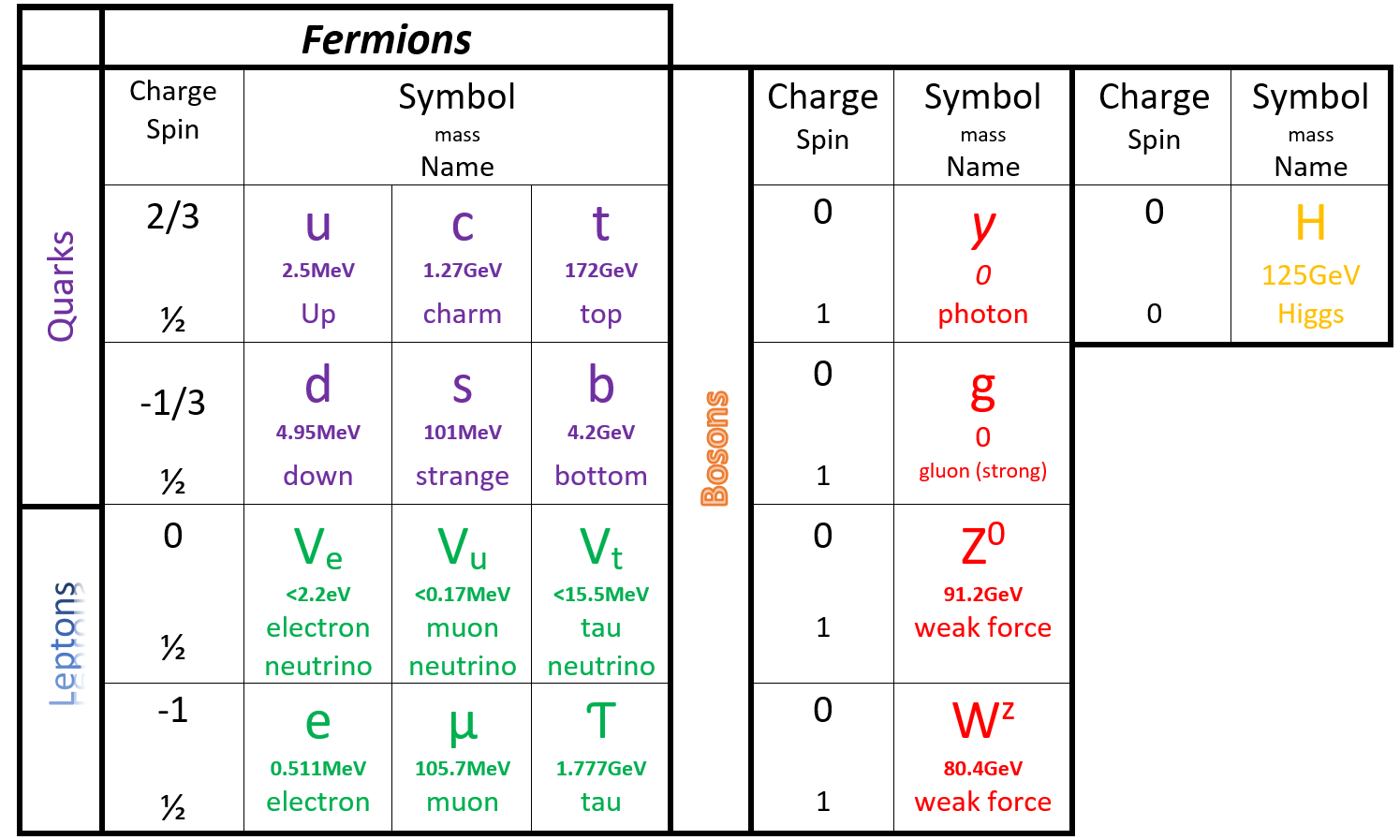
Table of Quantum Particles
Quantum properties
As with all particles, electrons can and do act as waves as well as the particles we imagine them to be. This, as we all know, is called the wave–particle duality and can be demonstrated using the double-slit experiment. The wave-like nature of the electron allows it to pass through two parallel slits simultaneously, rather than just one slit as would be the case for a classical particle. In quantum mechanics, the wave-like property of one particle can be described mathematically as a complex-valued function, the wave function, commonly denoted by the Greek letter psi (ψ). When the absolute value of this function is squared, it gives the probability that a particle will be observed near a location—a probability density.
Example of an antisymmetric wave function for a quantum state of two identical fermions in a 2-dimensional box. If the particles swap position, the wave function inverts its sign. Electrons are identical particles because they cannot be distinguished from each other by their intrinsic physical properties. In quantum mechanics, this means that a pair of interacting electrons must be able to swap positions without an observable change to the state of the system. The wave function of fermions, including electrons, is antisymmetric, meaning that it changes sign when two electrons are swapped; that is, ψ(r1, r2) = −ψ(r2, r1), where the variables r1 and r2 correspond to the first and second electrons, respectively. Since the absolute value is not changed by a sign swap, this corresponds to equal probabilities. Bosons, such as the photon, have symmetric wave functions instead. In the case of antisymmetry, solutions of the wave equation for interacting electrons result in a zero probability that each pair will occupy the same location or state. This is responsible for the Pauli exclusion principle , which precludes any two electrons from occupying the same quantum state. This principle explains many of the properties of electrons. For example, it causes groups of bound electrons to occupy different orbitals in an atom, rather than all overlapping each other in the same orbit.
What is all this Stuff
Quarks and Leptons are the building blocks which build up matter. They are considered the "elementary particles". In the present standard model, there are six "flavors" of quarks. They can successfully account for all known mesons and baryons (over 200). The most familiar baryons are the proton and neutron, which are each constructed from up and down quarks. Quarks are observed to occur only in combinations of two quarks (mesons), three quarks (baryons).
The masses should not be taken too seriously, because the confinement of quarks implies that we cannot isolate them to measure their masses in a direct way. The masses must be implied indirectly from scattering experiments. The numbers in the table could be different from numbers quoted elsewhere.
Each of the six "flavors" of quarks can have three different "colours". The quark forces are attractive only in "colorless" combinations of three quarks (baryons), quark-antiquark pairs (mesons) and possibly larger combinations such as the pentaquark that could also meet the colorless condition. Quarks undergo transformations by the exchange of W bosons, and those transformations determine the rate and nature of the decay of hadrons by the weak interaction.
What is Spin
In quantum mechanics and particle physics, spin is an intrinsic form of angular momentum carried by elementary particles, composite particles (hadrons), and atomic nuclei. Most things have spin. Particles of matter, such as electrons and quarks, all have spin 1/2 (called fermions). Particles of force or energy have integer spins: 0, 1, and 2 (called bosons). Fundamental particles are often thought of as infinitesimal points of zero size, making it difficult to imagine what it even means for them to rotate. We can, however, measure their angular momentum, and it seems to always come in discrete multiples of 1/2 like -1/2, 0, +1/2, +1, and nothing in between. This is a quantum mechanical effect, and each particle has an intrinsic or built-in angular momentum called spin. Particles of matter, such as electrons and quarks, all have spin 1/2 (called fermions), whereas particles of force or energy have integer spins: 0, 1, and 2 (called bosons). Photons, which are particles of light, can have spin -1 or +1, a phenomenon that is known to photographers as circular polarization. The SI unit of spin is the (N·m·s) or (kg·m2·s-1), just as with classical angular momentum. In practice, spin is given as a dimensionless spin quantum number by dividing the spin angular momentum by the reduced Planck constant ħ, which has the same units of angular momentum.
What’s this Mass in Electron Volts
The electron volt is a standard unit of energy in particle physics. One electron volt is the energy gained by an electron that is being accelerated by an electric potential difference ("electric voltage") of 1 volt. An example is typical energies of x-ray photons are in the keV range. The mass of an electron is 511 keV, that of a proton 938 MeV. It is a unit of energy which is of course mass.
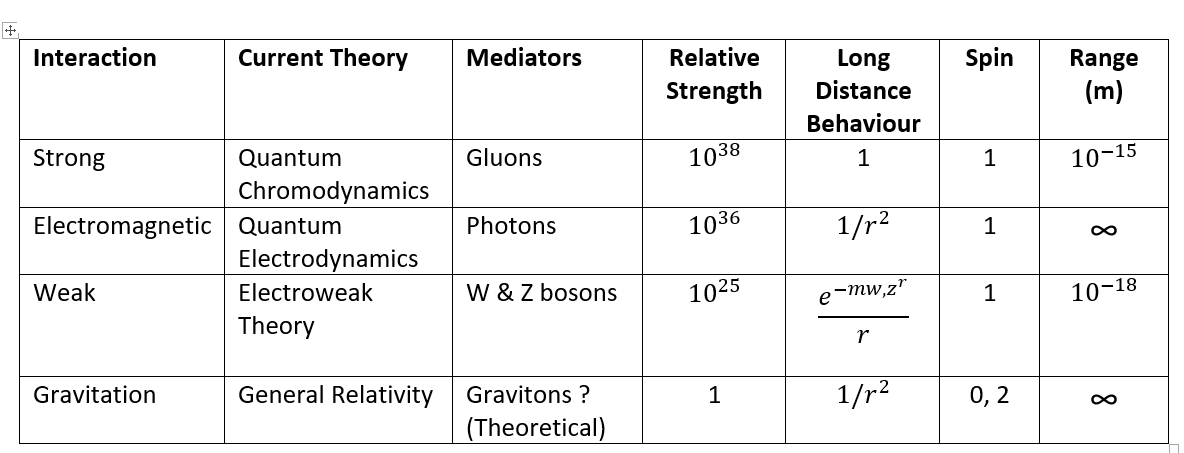
The Four Fundamental Forces of the Standard Model
|
|
Strong Force The strong force, which holds quarks and gluons together to form protons and neutrons, is the gluon. Also, quarks carry a colour charge and charges that are unlike attract each other. The strong force is responsible for bonding the quarks together and the residual strong force is what bonds the nucleus of atoms together. One needs to understand that the nucleus of an atom, which is held together by the strong force, also has the repulsion of the protons, they are positively charged. The distance that the strong force acts over is about the diameter of a proton so once the nucleons get close enough, such as in the fusion reaction of a star, then they can overcome the repulsion and bond. The strong interaction, observable at two ranges, is mediated by two force carriers. At about 1 to 3 fm (3 x 10-15m), the strong force is mediated by mesons. This is what binds protons and neutrons together and forms the nucleus of an atom. On the scale of about less than about 0.8 fm, which is the approximate radius of a nucleon, the strong force is carried by gluons. These hold quarks together to form protons, neutrons, and other hadron particles. This is termed the colour force. The strong force inherently has such a high strength that hadrons bound by the strong force can produce massively new particles. |
|---|---|
|
|
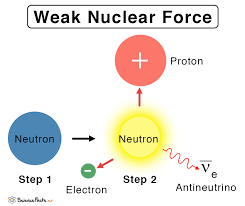
Weak Force The weak force is a fundamental force of nature that underlies some forms of radioactivity and is most seen in beta decay (radioactive decay in which an electron is emitted) and the associated radioactivity. It is involved with the decay of subatomic particles which are unstable, such as mesons, and initiates the nuclear fusion reaction that fuels the Sun. The weak interaction acts upon elementary particles with half-integer values of spin. The interaction occurs through the exchange of force-carrier particles known as the W+/- and Z gauge bosons. These particles are heavy, with masses of approximately 100 times the mass of a proton. It is because of their heaviness that the weak force has the extremely short-range nature and that makes the weak interaction appear weak at the low energies associated with radioactivity. The effectiveness of the weak interaction is confined to a distance range of 10−18 metre, about 1 percent of the diameter of a typical atomic nucleus. In radioactive decays the strength of the weak interaction is about 100,000 times less than the strength of the electromagnetic force. However, it is now known that the weak interaction has intrinsically the same strength as the electromagnetic force, and these two apparently distinct forces are believed to be different manifestations of a unified electroweak force. |
|
|
Electromagnetic The electromagnetic force has a positive and a negative charge demonstrated by the proton and the electron. The carrier boson is the photon. It is the electrical polarization of this force that is responsible for bonding the atoms to other atoms. It's called the electromagnetic force because it includes the formerly distinct electric force and the magnetic force; magnetic forces and electric forces are really the same fundamental force. If you could turn off the electromagnetic forces in an object then it would simply fall apart, all the molecules and their constituent atoms would disconnect. It is also sometimes called the also called the Lorentz force The force has an infinite distance for its effect. This is because its rest mass is zero. If the graviton is ever observed, then it is expected to have a rest mass of zero also. The electric force acts between all charged particles. The magnetic force acts between moving charged particles. This means that every charged particle gives off an electric field, whether it's moving or not. Moving charged particles (like those in electric current) will generate magnetic fields. Einstein developed his theory of relativity from the idea that if the observer moves with the charged particles, magnetic fields transform into electric fields and vice versa! One special case of the electromagnetic force, when all the charges are point charges (or can be broken up into point charges), is Coulomb's law. |
What is an Electron? This video goes into detail about what electrons really are, or more accurately what they think they are. It goes into great detail explaining that electrons are made of light. They discuss the problem with the model of electron as a point, Compton wavelength, polarization and how the electromagnetic and electrostatic fields are generated. They study the properties of a simple semi-classical model of a photon conned in periodic boundary conditions of one wavelength. The topology of this object, together with how the photon electric field, gives rise to a charge of the order of 1019 Coulomb and a half integral spin, independent of its size. The ratio of the electromagnetic energy inside and outside the object leads to an anomalous spin g factor which is close to that of the electron. Although a finite size of order 1012 meter arises in a natural way, the apparent size of the object will be much smaller in energetic scattering events.
Relative Strength of the four Fundamental Forces
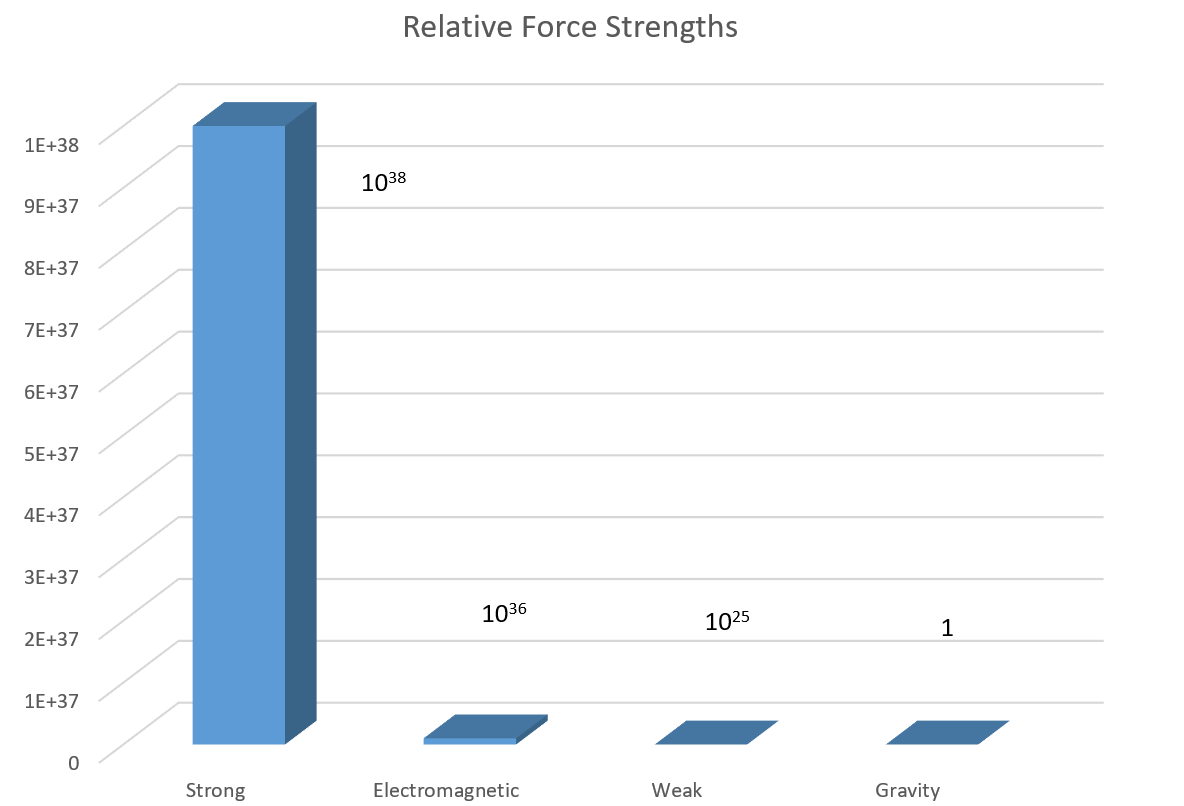
The Origins of Mass
Arvin Ash What is a Particle
How is mass and energy the same thing? What is mass really? If you weigh 80kg and are in a car moving 100km/hr, your energy is equal to about 30000 joules. But did you know that the energy you have standing still, not moving at all, is more than a hundred trillion times that, over 6*10^18 joules?
The followingt was copied directly from the sumary of the YouTube page
This comes from E=mc^2. But what is the nature of that energy? Is it due to movement at the quantum level? It is due to forces? How is it that mass can be the same as this energy. If it’s all energy, then is mass even a real thing?
What we call mass is made up of all the atoms in the rock. 99.99% of the mass of an atom is located in its tiny nucleus in the center, which makes up less than 0.01% of its volume. The rest is in the electrons that surround the atom.
There are two sources of mass. The known mass of fundamental particles comes from their interaction with the Higgs Field. This is like an energy grid. Different particles take different amounts of energy from it. But this makes up less than 1% of the mass of an atom. The other 99% of the mass is due to the strong force which keeps quarks bound within the nucleus of an atom.
A fundamental force of nature called the strong force that keeps these quarks bound together to form the proton nucleus. This force is mediated by gluons. But gluons are massless, so how are they responsible for so much mass? Gluons bind quarks together. And both have something called the color charge. This charge is how the strong force operates.
It’s somewhat analogous to an electrical charge where negatively charged electrons surrounding positively charged protons making the atom neutral. With quarks however, we deal with red, blue and green color charges that combine to form a neutral color. These are not optical colors, but metaphorically speaking, works similarly to the way red, blue and green optical colors can combine to form a neutral or white color.
Quarks exchange colors between themselves which is mediated by gluons. And it is this exchange which results in the strong force keeping them glued together. Why does color exchange keep them bound. This is due to confinement. What this means is that a color charged particle cannot exist on its own. Quarks and Gluons are color charged particles. Why? Because color charges exist can only exist in a combination of colors that is always neutral. This need for the combination of charges to exist as neutral, attracts red, blue and green color charged particles to each other.
This is quantum chromodynamics. It’s the science of the way the strong force works to keep the quarks inside the nuclei of atoms tightly bound together. This is the strong force. But how is this strong force creating mass? Mass is really just bound energy. The rest mass of an object is its intrinsic energy-content. It’s a type of potential energy. Any form of energy contributes to the mass of a body, potential or kinetic. The nature of this energy doesn’t matter. So for example, a compressed spring is a little bit heavier than the same spring without the potential energy stored in its compression. You don’t notice this mass difference because at our scales, these energies contribute very little to the mass.
What exactly is mass then? Well, we measure it often as weight if you happen to have a gravity well available to pull on it. We heard the Higgs boson is responsible for transmitting mass, but what produces it? Apparently, most of the mass is in the nucleus of the atom, electrons are quite small relative to a nucleus but, guess what, they can’t find most of it. When you add it up, it just isn’t there.
We all know that protons and neutrons are made up of particles called quarks and are stuck together with gluons. Gluons are massless, and it seems that the sum of the masses of the quarks inside protons and neutrons makes up only a small percent of the nucleons’ total mass. According to their results, the up quark weighs approximately 2 mega electron volts (MeV), which is a unit of energy, the down quark weighs approximately 4.8 MeV, and the strange quark weighs in at about 92 MeV. The mass of a proton is 1.6726219 × 10⁻²⁷ kilograms or 938.28 MeV. A proton is comprised of two up quarks and one down, for a total of about 8.8 MeV, so where does the rest come from?
Scientists are proposing that spin, mass, and other nucleon properties which result from the complex interactions of the quarks and gluons within are responsible for the extra mass, but how this works is unknown. A deeper understanding of the protons and neutrons is required it seems. So how can one look inside a nucleon? Use an electron Ion Collider (EIC).
Unlike an atom smasher, such as CERN, which hurtles nucleons, protons usually, at each other at near light speed, electrons have no complex structure within them and can be used to ‘see’ inside the protons more clearly. If I understand the process correctly it is like using the electron in much the same way as we use a photon in a microscope or perhaps even an interferometer. That last one needs to be verified.
An EID would accelerate electrons in one direction and protons in the other and smash them into each other. This would allow scientists studying quantum chromodynamics to look deeply inside the nucleus of an atom and to be able to study the strong nuclear force in more detail than with the Large Hadron Collider (LHC). With a combination of linear accelerators and synchrotrons they would achieve energy levels of 100GeV. This is much lower than the LHC but with the electrons colliding with the proton a different set of data is achievable. They expect to have an EIC in operation by 2030, the Thomas Jefferson National Accelerator in Virginia USA, https://www.jlab.org/.
How does it work? The proton, as we know, is composed of quarks and gluons. Gluons are the carriers of the force that binds quarks together. Free quarks are never found in isolation—that is, they are confined within the composite particles in which they reside. The origin of quark confinement is one of the most important questions in modern particle and nuclear physics because confinement is at the core of what makes the proton a stable particle. The internal quark structure of the proton is revealed by Compton scattering, a process in which electrons are scattered off of quarks inside the protons, which in turn emit high-energy photons, which are detected in coincidence with the scattered electrons and recoiled protons. Using this technique measurements of the pressure distribution experienced by the quarks in the proton is available. There is a strong repulsive pressure near the center of the proton (up to 0.6 femtometres) and a binding pressure at greater distances. The average peak pressure near the centre is about 1035 pascals, which exceeds the pressure estimated for the most densely packed known objects in the Universe, neutron stars. This work opens a new area of research on the fundamental gravitational properties of protons, neutrons and nuclei, which can provide access to their physical radii, the internal shear forces acting on the quarks and their pressure distributions.
Under Pressure
Inside every proton is a high-pressure environment that is greater than the forces that are experienced at the heart of a neutron star according to some of the first measurements. The physicists found that the quarks are subjected to a pressure of 100 decillion Pascal (1035) near the center of a proton, which is about 10 times greater than the pressure in the heart of a neutron star. Could the energy stored in this pressure represent the missing mass, I ask.
Physicists calculate proton’s pressure distribution for first time >
Causal Order at the Quantum Level
It has been confirmed experimentally that quantum mechanics allows events to occur without definite causal order. Jacqui Romero, Fabio Costa and their colleagues at the University of Queensland in Australia, say that gaining a better understanding of this indefinite causal order could offer a route towards a theory that combines Einstein’s general theory of relativity with quantum mechanics.
With the everyday life of classical physics there are strict causal relationships between consecutive events. Any events that come later in time cannot affect events that happened prior in time. The relationship breaks down in quantum mechanics due to the temporal spread of a particles’ wave function over time. This spread can be greater than the separation in time between events and hence later events can cause an effect onto an earlier one.
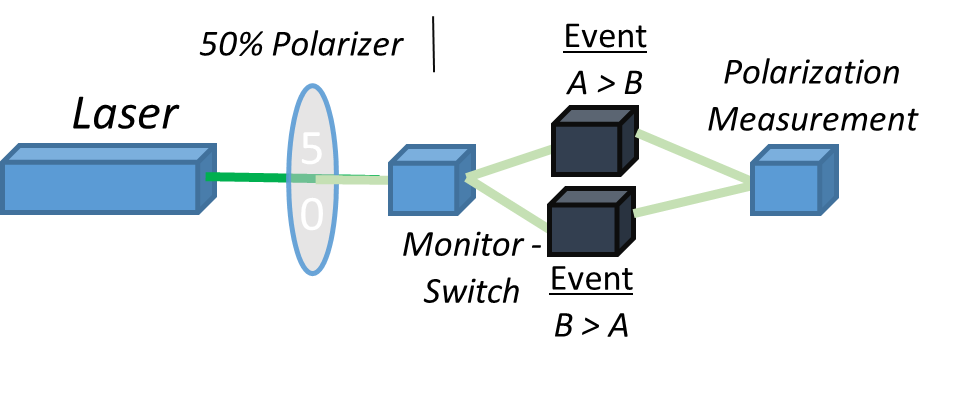 In their experiment the team created a photonic quantum switch – basically a gate mechanism built from a single atom, that can be turned on and off by using a single photon. Using this switch the photons can take one of two paths. One path involves being subjected to operation A before operation B, while in the other path B occurs before A. The order in which the operations are performed is determined by the initial polarization of the photon as it enters the switch. They used a polarizing beam splitter sending photons of different polarizations along different paths. With the photon source diagonally polarized with respect to the beam splitter, there is a 50% chance that a photon will take one route or the other.
The two paths are then recombined, and the polarization of the photons are measured. The operations A and B are designed such that the order in which they are applied to the photons affects the polarization of the output photons – if the system has definite causality. The conclusion is that the two possible operations can exist in a superposition of their two possible orders. By changing the polarisation of the photons, the scientists were able to demonstrate that one did not need to precede the other.
The team did the experiment using several different types of operation for A and B and in all cases, they found that the measured polarization of the output photons was consistent with their being no definite causal order between when A and B was applied. Indeed, the measurements backed indefinite causal order to a whopping statistical significance of 18σ – well beyond the 5σ threshold that is considered a discovery in physics.
Physicists observe causation violation at quantum level >
Detecting Neutrinos
Various detection methods have been used to detect neutrinos. The IceCube neutrino detector in Antarctica, a CERN experiment. IceCube is designed to look for point sources of neutrinos in the teraelectronvolt (TeV) range to explore the highest-energy astrophysical processes. It has detected neutrinos that likely originated outside the Solar System in 2013.
There is the Super Kamiokande which uses a large volume of water surrounded by phototubes. They watch for the Cherenkov radiation emitted when an incoming neutrino creates an electron or muon in the water. It detected neutrinos from SN 1987A, a supernova which was observed in the Large Magellanic Cloud in February 1987, and to observe solar neutrinos in 1988.
The Sudbury Neutrino Observatory is similar, but uses heavy water as the detecting medium. There are also other detectors which use large volumes of chlorine or gallium where they look for excesses of argon or germanium, respectively, which are created by neutrinos interacting with the original substance. MINOS uses a solid plastic scintillator watched by phototubes; Borexino uses a liquid pseudocumene scintillator also watched by phototubes; and the NOνA detector (SNO) uses a liquid scintillator watched by avalanche photodiodes. So there are many different ways to detect the existence of neutrinos but there doesn't seems to be as many as they expected.
Physicists have spotted neutrinos pinging off atomic nuclei in a way predicted more than 40 years ago, but never before observed. The first measurements of the number of solar neutrinos reaching the Earth were taken in the 1960s, and all experiments prior to SNO observed a third to a half fewer neutrinos than were predicted by the Standard Solar Model.
Quantum Bayesianism
 The Quantum
Quantum mechanics is a very successful theory but it seems to be full of paradoxes. A recently developed model called Quantum Bayesianism (QBism) combines quantum theory with probability theory in an effort to put the paradoxes to rest.
QBism looks at the wave function in a different way. The wave functions, as we know are used to calculate probabilities that systems will take on certain states. But paradoxes arise when physicists take wave functions to be real.
QBism asserts that the wave function is merely a mathematical tool used by an observer to assign a subjective belief that a quantum observation will reveal a specific property. To QBists, wave functions do not exist in the world; they simply reflect individuals' uncertain and changing beliefs about what is probable.
This is a very detailed and abstract explanation of Quantum Bayesianism. It is a very detailed explanation so I suggest making yourself very comfortable before listening to it.
The Nobel Prize in physics in 2022 went to scientists who, for over 40 years, have carried out a series of experiments indicating that, contrary to materialist expectations, physical entities do not have standalone existence but are, in fact, products of observation. This result is extraordinarily relevant to our understanding of the nature of reality, and so Essentia Foundation, in collaboration with the Institute for Quantum Optics and Quantum Information, Vienna, of the Austrian Academy of Sciences (home to Prof. Anton Zeilinger, one of 2022's Nobel Laureates in physics), organized a conference discussing the implications of this result. The conference was hosted by IQOQI-Vienna’s Dr. Markus Müller and featured seven other speakers.
In this presentation, Dr. Jacques Pienaar discusses the notion of an embodied agent in the context of Quantum Bayesianism ('QBism,' for short). QBism is an interpretation of quantum mechanics according to which the wave function represents simply what we know about reality—a kind of betting strategy about what we will see next—as opposed to reality itself.
 What is It?
What's it about? The observer employs the wave function to assign his or her belief that properties of a quantum system will have particular values, realizing that one's own actions affect the system and change those properties in inherently uncertain ways. Another observer, using a wave function that describes the world as that person sees it, may come to a completely different conclusion about the same quantum system. One system—one event—can have as many different wave functions as there are observers. After they have communicated with one another and modified their private wave functions to account for the newly acquired knowledge, a coherent worldview emerges.
The wave function is just a tool that tells observers how to calculate their personal beliefs, or probabilities, about the quantum world around them.
 QBism is the notion that until an experiment is performed, its outcome simply does not exist.
An example is before an electron is actually observed the particle exists and moves, but it does not have a speed or a position. Those “properties” have meaning only following an observation; it is the act of measurement that creates them. As participants in quantum experiments, we thus become active contributors to the ongoing creation of the universe.
Bayesian Probability
Bayesian probability is a quantity that we assign to represent a state of knowledge, or a state of belief. In the Bayesian view, a probability is assigned to a hypothesis, whereas under frequentist inference, a hypothesis is typically tested without being assigned a probability. This is in contrast to interpreting probability as frequency or propensity of some phenomenon.
Waves
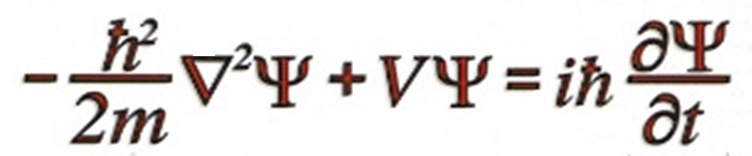 The notion that the wave function isn't real dates back to the 1930s and the writings of Niels Bohr, one of the founding fathers of quantum mechanics. He considered it part of quantum theory's “purely symbolic” formalism—a computational tool, no more. QBism is the first model to give mathematical backbone to Bohr's assertion. It melds quantum theory with Bayesian statistics, a 200-year-old discipline that defines “probability” as something like “subjective belief.” Bayesian statistics also gives formal mathematical rules for how to update one's subjective beliefs in light of new information. By interpreting the wave function as a subjective belief and subject to revision by the rules of Bayesian statistics, the mysterious paradoxes of quantum mechanics vanish, QBism's proponents say.
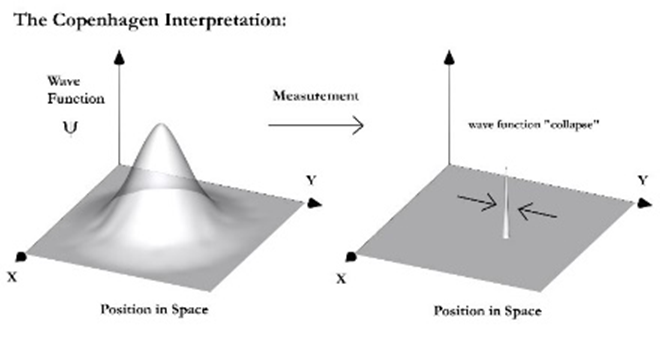
Consider again an electron in an atom. We set up an experiment to detect the particle, and we find it in one particular location. But as soon as we stop looking, the electron's wave function spreads out. That seems to imply that the electron could be in many different places at once. Yet whenever we detect the particle again, we always find it occupying just one position. According to the standard way of thinking, the act of observation causes the wave function to instantaneously “collapse,” snapping the electron into a particular location.
Because the collapse happens everywhere at exactly the same time, it seems to violate the principle of locality—the idea that any change in an object must be caused by another object in its immediate surroundings. This, in turn, leads to some of the puzzles that Albert Einstein called “spooky action at a distance.”
From the very birth of quantum mechanics, physicists saw the collapse of the wave function as a paradoxical and deeply disturbing feature of the theory. Its uneasy mysteries pushed physicists to develop alternative versions of quantum mechanics, with mixed success.
Yet QBism says that there is no paradox. The wave function's collapse is just an observer suddenly and discontinuously revising probability assignments based on new information, in the same way that a doctor would revise a cancer patient's prognosis based on a new CT scan. The quantum system hasn't undergone some strange and inexplicable change; the change is in the wave function, which is chosen by the observer to encapsulate the person's expectations.
We can apply this way of thinking to the famous paradox of Schrödinger's cat. Quantum physicist Erwin Schrödinger imagined a sealed box with a live cat, a vial of poison and a radioactive atom. The atom has a 50–50 chance of decaying within an hour, according to the rules of quantum mechanics. If the atom decays, a hammer will smash the vial and release the poison, killing the cat. If it doesn't, the cat lives.
Now run the experiment—but don't look inside the box. After an hour has gone by, traditional quantum theory would hold that the atom's wave function is in a superposition of two states: decayed and not decayed. But because you haven't yet observed what is inside the box, the superposition extends further. The hammer is also in a superposition, as is the vial of poison. And most grotesquely, the standard quantum-mechanical formalism implies that the cat is in a superposition—it is both alive and dead at the same time.
By insisting that the wave function is a subjective property of the observer, rather than an objective property of the cat in the box, QBism eliminates the puzzle. Common sense says that of course the cat is either alive or dead (and not both). Sure, the wave function of this system represents a superposition of “alive” and “dead,” but a wave function is just a description of the observer's beliefs. Asserting that the cat is truly both alive and dead is akin to a baseball fan saying that the Yankees are stuck in a superposition of both “won” and “lost” until the person sees the box score. It's an absurdity, a megalomaniac's delusion that one's personal state of mind makes the world come into being.
The hope is that by removing the paradoxes, QBism will help physicists home in on the truly fundamental features of quantum theory.
Links
Most of the content of this portion of the document about QBism came from a Scientific American article by Hans Christian von Baeyer. ”Quantum Weirdness is all in your Mind”
Have We Really Found The Theory Of Everything?
Are we there yet? This video looks at where we are for the theory of everything and looks at it from all angles. It takes you from the general theory through quantum chromodynamics and then includes an explanation of how string theory goes through its failings and tied into M theory, that may be the answer, but there’s more to it than that. They speak to quantum gravity also explained with string theory.